Practice · August 4, 2026 · 11 min · Joshua Dear
GPT-5.6 and Mythos-class Claude: you're probably using them wrong
As of GPT-5.6 and Anthropic’s Mythos 5 era, both models are extraordinary — and most people still trap them in a browser tab. The desktop apps (ChatGPT Work and Codex, Claude Cowork and Code) are where the real work happens.
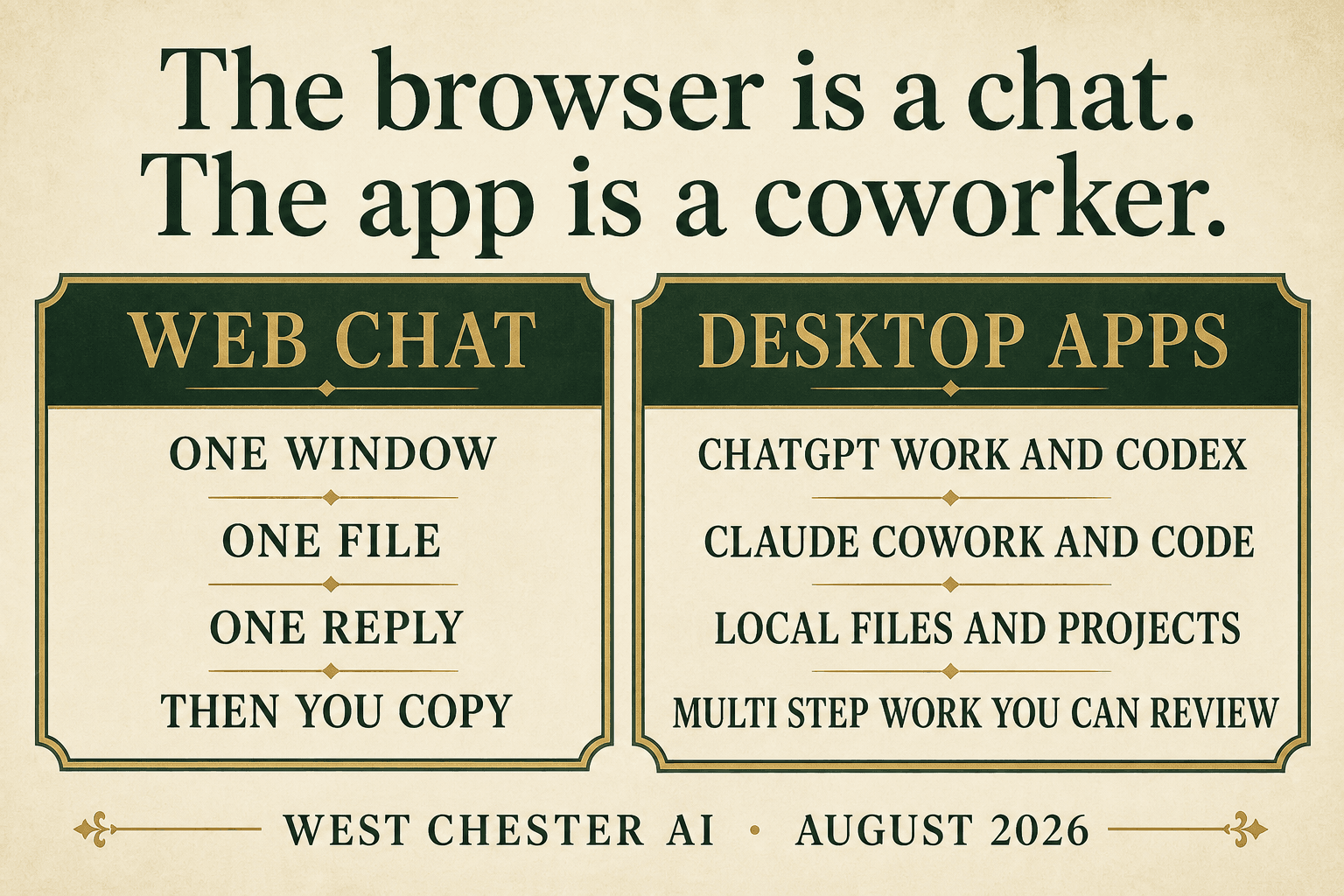
This is written in August 2026, after OpenAI shipped GPT-5.6 and Anthropic shipped the Mythos 5 generation. Both are astonishing. Both will make you feel, for a minute, that the old “which chatbot?” debate is over. And both are being used badly — usually in the same way: a browser tab, a clever prompt, a copy-paste, a hope that nobody checks the numbers.
The models are not the bottleneck anymore. The interface is. We all started in the web chat because that is where ChatGPT and Claude arrived. That window is still fine for a question. It is the wrong place for a project. If you can download the apps, do it. ChatGPT’s desktop app now holds Chat, Work, and Codex. Claude’s desktop app now holds Chat, Cowork, and Code. Those modes can reach your files, keep a project alive, write software you could not write by hand, and run multi-step work while you review. The website cannot match that.
The model is the engine. The app is the shop floor. Most people are still shouting through the showroom window.
What “Mythos 5” means if you are not a lab
A naming note, because the internet is already confusing it. Anthropic’s Mythos 5 is the frontier class. The version most people can actually use is Claude Fable 5 — a Mythos-class model made safe for general release. Mythos 5 itself is limited (trusted access / specialized partners). For a business owner comparing “ChatGPT vs Claude” this week, the honest pairing is GPT-5.6 on the ChatGPT side and Fable 5 (Mythos-class) in Claude Cowork or Code. Same generation of ambition. Different front doors.
GPT-5.6 in ChatGPT Work comes in flavors — Sol for the hardest computer-use and coding, Terra for everyday professional work, Luna when you need speed. You do not need to memorize the menu on day one. You do need to leave the browser.
The apps: ChatGPT Work and Claude Cowork
ChatGPT Work is an agent sitting on GPT-5.6. You give it an outcome. It plans steps, pulls context from files and connected tools, can use a built-in browser, and — on desktop — can use the computer: clicking, typing, moving files. It is built to leave you a packet: a spreadsheet, a deck, a document that follows your template, even a small hosted site. Codex lives in the same desktop app if the work is software. You do not have to be a developer to benefit. You do have to watch what it touches.
Claude Cowork is Anthropic’s answer for everyone who is not living in a terminal. Same agentic idea as Claude Code, aimed at research, analysis, documents, and the mess of a real folder. You point it at work on your machine (and, increasingly, pick it up on web and phone). Claude Code — in the desktop Code tab, the terminal, or an IDE — is the engineering twin: write, debug, ship. If ChatGPT Work feels like a project manager who also designs the slides, Cowork feels like a careful colleague who will live in your files until the memo is done.
- Projects persist. The chat tab forgets your standards. A project remembers the files, the brief, and the last pass.
- Local files change the game. The model can draft from the actual contract, the actual CSV, the actual brand folder — not a screenshot you uploaded once.
- You can get software without becoming a programmer. Ask for a tracker, a landing page, a cleanup script. Then have it explain every file it created.
- Computer use is power and risk. If it can click, it can click the wrong thing. Set approvals. Watch the first runs.
How the two models actually differ
They are both excellent. Treating that as a team rivalry is a waste of a year. The useful differences show up when you give them the same hard job.
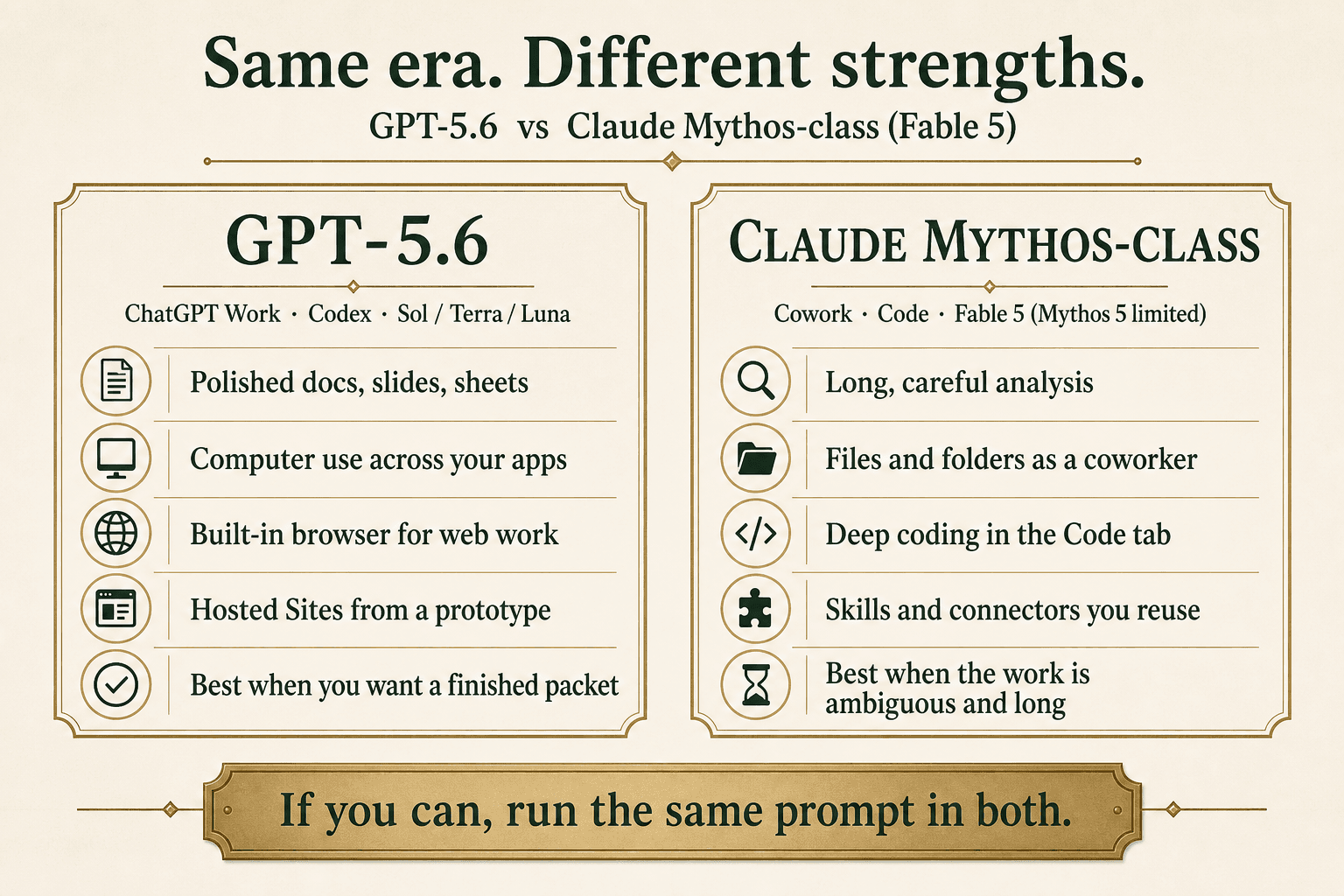
GPT-5.6, especially in Work, is a closer. It wants to hand you something that looks done: formatted, presented, moved across apps. It is often faster to a shareable artifact. It will happily operate the machine. That is a gift for operators, marketers, and anyone whose job is a stack of tools. The failure mode is polish over proof — a beautiful deck with a soft number, a site that looks live and is wrong in row three.
Mythos-class Claude (Fable 5 in Cowork and Code) is a stayer. Anthropic built this generation for long, messy, end-to-end work — the thing that used to take a person hours or days. It is unusually good at following a written process, keeping constraints, and sitting with a codebase or a research pile without getting bored. The failure mode is caution and slowness: it may refuse a technical topic that is actually benign, or write you a careful essay when you wanted a file. In Code, it can go very deep. You still read the diff.
| GPT-5.6 (ChatGPT Work / Codex) | Mythos-class Claude (Cowork / Code) | |
|---|---|---|
| Feels like | A producer who ships the packet | A colleague who lives in the files |
| Sweet spot | Docs, slides, sheets, browser tasks, computer use | Long analysis, research, software, following a brief |
| App to open | Desktop: Chat, Work, Codex | Desktop: Chat, Cowork, Code |
| If you don't code | Work can still build sites and files you can click | Cowork can still run a multi-step job in your folders |
| Watch for | Confident polish, shared usage across Work and Codex | Over-caution, or a long run you did not supervise |
| Human job | Approve computer-use and check every figure | Read the trail and ask it to justify each step |
Copy the prompt. Send it twice.
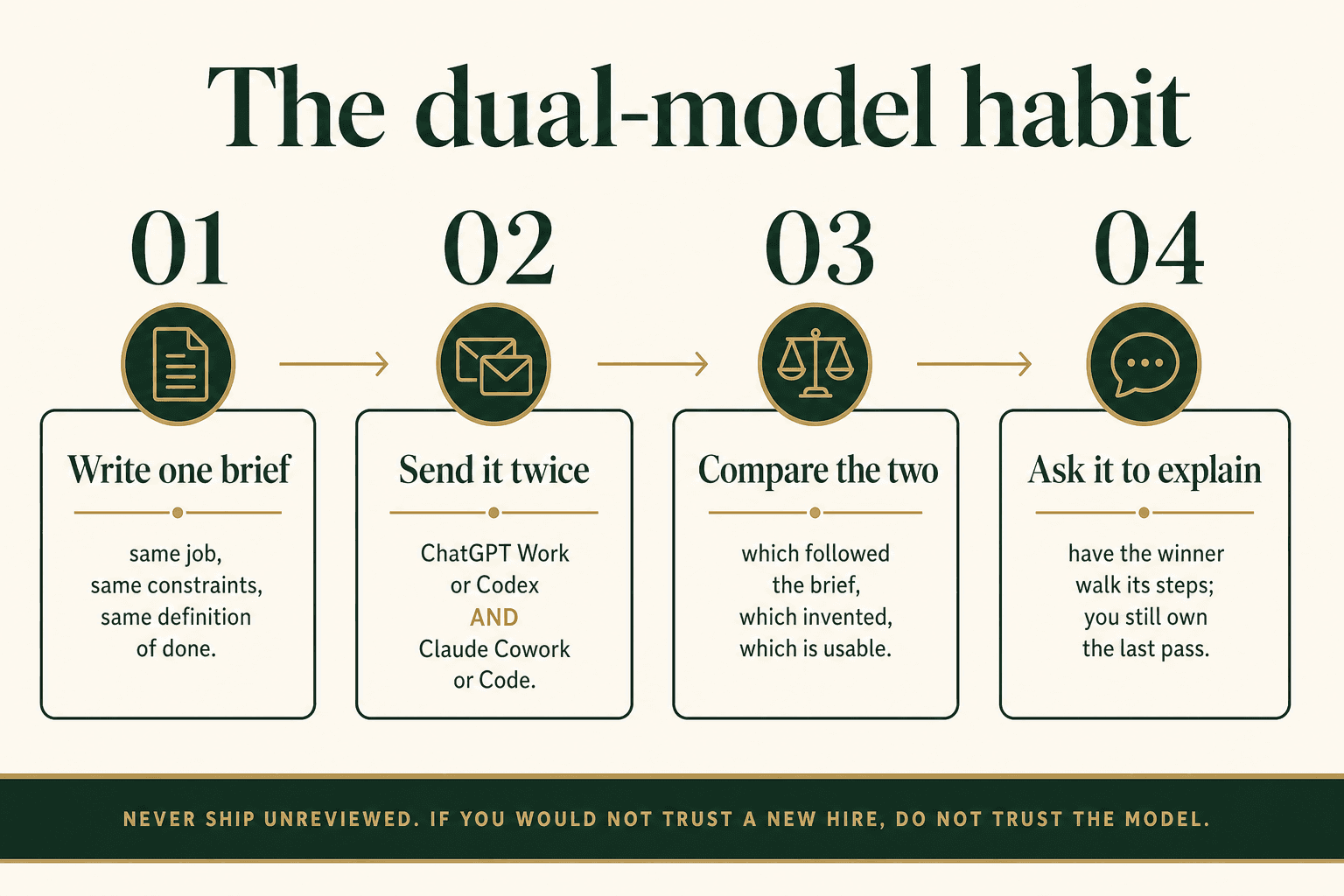
If you can afford one paid seat on each side — or even a trial week — do the unfashionable thing. Write one brief. Same constraints. Same “done.” Paste it into ChatGPT Work and into Claude Cowork (or Codex and Code if it is software). Do not coach the second one with what the first said. Compare.
- Which one followed the brief instead of inventing a nicer assignment?
- Which one cited a source you can open?
- Which one produced a file you would actually send?
- Which one explained its steps without being asked — and which one needs to be asked?
You will not get a permanent winner. You will get a map. Some weeks GPT-5.6 is the closer. Some weeks Claude is the only one that understood the contract. Keeping both is not indecision. It is quality control.
Always check. Make them show their work.
These systems can now do work that used to require a junior hire and a week. They can also fabricate a citation, misread a spreadsheet, and refactor the wrong folder with perfect manners. The rule has not changed: if you would not trust a new colleague unreviewed, you do not trust the model unreviewed.
Use the apps’ review features. Watch computer-use. Read the file list. Then ask, out loud in the thread: “Explain what you did, in order. What did you assume? What did you not open? What should I verify before this leaves the office?” A model that cannot answer that is not done. A model that answers clearly still needs you.
The app lets you do more. It does not let you skip the last pass.
If you want help installing the right app, picking GPT-5.6 vs Fable 5 for a real weekly job, and building a review habit your team will actually use — book a complimentary Discovery Call. Bring one messy project, not a brand strategy. We will run it in the tools, not in a slide about the tools.